

How to Push Down Negative Search Results on Google (A 2026 Guide)
The digital landscape of 2026 has witnessed a fundamental paradigm shift, moving from a retrieval-based model focused on link equity toward a reasoning-based ecosystem governed by entity clarity and…
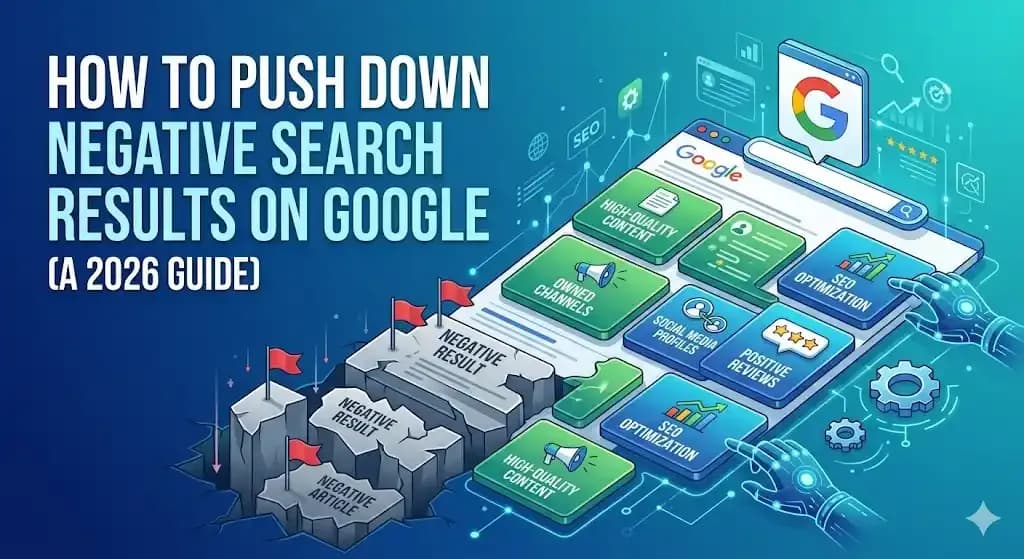
The digital landscape of 2026 has witnessed a fundamental paradigm shift, moving from a retrieval-based model focused on link equity toward a reasoning-based ecosystem governed by entity clarity and verifiable experience. This transition, often referred to by industry practitioners as the "Great Reset," has rendered the legacy tactics of the 2024–2025 era—primarily high-volume AI content production and aggressive link building—not only ineffective but actively toxic to a domain's reputation. For professionals tasked with the suppression of negative search results, the current environment demands a sophisticated understanding of how Google’s March 2026 Core Update has rebalanced the weighting of quality signals in favor of real-world authority and human-centric expertise.
Online Reputation Management (ORM) in 2026 is no longer a reactive exercise in damage control; it has evolved into a discipline of digital authority engineering. The objective is to construct a robust "Knowledge Graph" around an entity—be it a high-profile executive, a corporation, or a professional service—that provides an algorithmic stamp of authority so strong that negative, outdated, or misleading content is naturally deprioritized by Google’s synthesis engines. This report provides an exhaustive technical roadmap for navigating this new reality, integrating the latest algorithmic insights, technical SEO strategies, and legal removal frameworks available as of May 2026.
The 2026 Search Environment: Algorithmic Foundations and Volatility
The spring of 2026 marked one of the most volatile periods in the history of search, characterized by a rapid succession of three major algorithm updates within a four-week window. The centerpiece of this cycle was the March 2026 Core Update, which concluded on April 8, 2026, and achieved a volatility reading of 9.5 out of 10 on the Semrush Sensor—the highest recorded level of the year.3 This update was not merely a refinement of existing signals but a total reset of how Google reassesses the entire playing field to determine which pages deserve prominence.
The Core Update Cycle: Timeline and Strategic Implications
The March 2026 Core Update was preceded by a significant Spam Update on March 24, which "cleared the table" by targeting scaled content slop and expired domain abuse before the core ranking signals were recalibrated. This two-stage process suggests that Google’s systems have become significantly more decisive in identifying and filtering low-value content that rehashes top results without adding unique value or "information gain".
Update Milestone | Date Range (2026) | Duration | Primary Strategic Objective |
Discover Core Update | February 5 – February 26 | 21 Days, 17 Hours | Enhancing topical expertise and originality in Discover feeds |
March Spam Update | March 24 – March 25 | 19 Hours, 30 Minutes | Eliminating scaled AI-slop and expired domain abuse |
March Core Update | March 27 – April 8 | 12 Days, 4 Hours | Re-evaluating quality and E-E-A-T across the broad index |
April Core Update | Rolled out April 14 | Ongoing | Broad quality and relevance signals across all device types |
The speed with which the March Core Update was completed—12 days compared to the 18 days required for the December 2025 update—indicates that Google’s quality signals have reached a level of maturity where the classification of high-quality versus low-quality content is near-instantaneous. For reputation management, this means that the "settled reality" after an update is likely to persist until the next major cycle, making the immediate implementation of quality-first strategies essential for recovery or suppression.
The Rise of Generative Engine Optimization (GEO)
Traditional search results are increasingly being superseded by AI Overviews (AIO), which now appear in approximately 55% of all Google searches. This evolution has fundamentally altered the "Rank and Click" model that dominated the SEO industry for two decades. AI Overviews aggregate information from multiple sources to provide a cohesive, synthesized answer directly on the search page, leading to a "zero-click" environment where organic click-through rates (CTR) for informational queries have dropped by as much as 34% to 58%.
In this landscape, visibility is no longer defined by holding a top-10 blue link but by being selected as a "Core Knowledge Source" for the AI’s synthesis. Reputation managers must shift their focus from driving traffic to increasing "Inclusion Rates" within the AI summary. Being cited within an AI Overview provides a verified stamp of authority that can influence user perception even if no click occurs. Conversely, if an AI summary reflects negative sentiment—often due to a fragmented or unhealthy underlying review and forum environment—the damage to a brand's reputation is immediate and difficult to mitigate without addressing the source data.
E-E-A-T as the Primary Engine of Suppression
In 2026, the framework of Experience, Expertise, Authoritativeness, and Trustworthiness (E-E-A-T) has moved from a theoretical guideline to the primary differentiator in organic rankings. The March 2026 Core Update specifically elevated "Experience" signals, rewarding content that demonstrates genuine, firsthand engagement with the subject matter.
Experience: The New Threshold for Credibility
The addition of the first "E" for Experience in late 2022 was a precursor to the current environment where Google’s algorithms can distinguish between content written by a practitioner and content summarized by a researcher or an AI model. For suppression assets to be effective, they must satisfy the "Experience" requirement through specific, verifiable details that are difficult to replicate.
Technical markers of experience in 2026 include:
- Original Media: Use of unfiltered photos taken on a mobile device, raw dashboard screenshots, process diagrams, or event recordings rather than polished stock photography.
- Measurable Outcomes: Documentation of real-world results, such as "how we reduced a client's crisis-related search volume by 40% in 90 days," featuring concrete timelines and constraints.
- Behind-the-Scenes Insights: Detailed explanations of delivery processes, including challenges faced and lessons learned, which signal lived involvement.
- Experiential Anchors: The integration of at least one verifiable detail—such as a specific tool version or a named platform used in practice—within every major section of content.
The "100-Word Rule" is now a standard for professional content creators: the opening paragraph of any authoritative asset must establish the author's direct relationship to the topic to satisfy E-E-A-T requirements immediately.
Expertise and Authoritative Infrastructure
Expertise in 2026 is defined by depth and clarity, moving beyond surface-level summaries to provide comprehensive resources like whitepapers or ebook-style long-form guides. Authoritativeness, meanwhile, is built through "consistent authorship" and the creation of "Topic Clusters" that demonstrate a command of a subject area over time.
E-E-A-T Component | 2026 Professional Standard | ORM suppression Impact |
Experience | Real-world case studies, original screenshots, and firsthand narratives. | High-authority personal accounts can outrank generic negative news stories. |
Expertise | In-depth guides that answer "how" and "why," supported by technical terminology. | Deep expertise assets establish the brand as a "Core Knowledge Source" for AI. |
Authoritativeness | Verified bylines across multiple high-DR platforms and industry citations. | Consistent authorship signals help Google disambiguate the entity from negatives. |
Trustworthiness | Transparent "About Us" pages, secure HTTPS, and verifiable contact info. | Trust is the "glue" that prevents AI systems from citing misleading or negative sources. |
Trust remains the most critical component; without it, experience and expertise are discounted by the algorithm. For reputation management, this means that every controlled asset must be transparent about its administrators, its safety (HTTPS), and its honesty.
Technical Reputation Engineering: Knowledge Graph Optimization
The technical layer of ORM has shifted from simple keyword optimization to "Entity Building" and Knowledge Graph engineering In 2026, search engines act as "analysts" that decompose questions and verify facts against a structured network of entities—people, places, brands, and concepts.
The Entity Home and Disambiguation
For an individual or organization to suppress negative search results effectively, they must define an "Entity Home"—typically a self-owned "About Us" or personal bio page that acts as the authoritative source of truth for Google's Knowledge Graph. This page serves as the anchor for "Entity Disambiguation," ensuring that the search engine does not confuse the target entity with others who share a similar name or are associated with negative events.
Consistency is the primary trust signal for disambiguation. Discrepancies in data—such as a LinkedIn profile listing an individual as "CEO" while their personal website says "Founder"—create "Data Friction," which can delay or prevent the creation of a verified Knowledge Panel. Reputation managers must standardize biographies and contact information across every digital touchpoint.
Advanced Schema Markup Strategies for 2026
Schema markup has evolved into "ranking infrastructure" rather than optional metadata. Google’s Gemini-powered systems use structured data to verify claims, establish entity relationships, and assess source credibility during answer synthesis. The 2026 strategy emphasizes "Entity Depth" over simple tag implementation.
Key schema types for reputation suppression include:
- Organization Schema: Defines the foundation of the brand entity, including identifiers like DUNS or GS1 numbers.
- Person Schema: Essential for executive branding, providing a "verified, algorithmic stamp of authority".
- sameAs Property: The most critical tool for ORM, as it explicitly links the Entity Home to professional profiles (LinkedIn, Twitter), contributor pages (Forbes), and industry associations, creating a "web of identity".
- knowsAbout Property: Declares specific areas of expertise, which increases the likelihood of being cited by AI Overviews for queries in those domains.
- mainEntityOfPage: Explicitly tells the search engine which entity the page is about and how it should be classified.
Schema Priority | Strategic Focus | Expected Outcome |
High | Organization + sameAs | Verified entity status in Knowledge Graph; Knowledge Panel creation. |
High | Person + knowsAbout | Increased citation frequency in AI Overviews for expert queries. |
Medium | Article + Author Bio | Elevated Page Authority through verifiable author credentials. |
Medium | AggregateRating (Verifiable) | Enhanced rich snippets in traditional SERPs to increase CTR for positive assets. |
The March 2026 update also introduced stricter enforcement of "Content Parity"—every piece of data declared in the JSON-LD schema must match visible on-page content, or the site faces "Spammy Structured Data" flags.
Content Suppression and High-Authority Asset Development
The core strategy for pushing down negative search results remains the creation and optimization of controlled, positive assets that occupy first-page real estate. In 2026, this requires an "Omnichannel" approach that aligns SEO, AI optimization, and social distribution to dominate visibility across multiple ecosystems.
Strategic Platform Selection for 2026
The selection of platforms for suppression content is based on their "Domain Authority" and their likelihood of being cited by AI systems. High-authority platforms serve as "protective shields" by ranking above negative news stories or forum threads.
Platform Category | Leading Websites (2026) | Strategic Value for ORM |
Professional | LinkedIn, Crunchbase, Angel.co | Dominates professional queries; builds B2B authority. |
Social | Facebook, Instagram, Twitter (X) | Provides high-volume engagement signals and local marketing trust. |
Synthesis/QA | Reddit, Quora, Medium | Primary sources for AI model training and answer synthesis. |
Multimodal | YouTube, Vimeo, Pinterest, Behance | Captures real estate in video and image carousels. |
Trust/Review | Trustpilot, Yelp, Sitejabber | Controls the review signals that AI uses to summarize brand sentiment. |
The 2026 environment places a premium on "multimodal" search, meaning that video content—specifically short-form explainers or owner interviews—is often prioritized by Google as more trustworthy than text-only articles.
The Role of User-Generated Content and Forums
Reddit and Quora have become central to the 2026 ORM strategy. Approximately 5.5% of all AI Overviews now pull information directly from Reddit, as Google’s AI models prioritize community-validated insights over corporate marketing copy. For reputation management, this means that "Shadow ORM"—the practice of fostering authentic positive discussions on third-party forums—is often more effective at influencing AI sentiment than publishing on owned domains.
Link Building as Authority Stacking
The era of "Link Building + ChatGPT" is officially over. Google’s SpamBrain system now identifies 200x more spam than manual reviews, and links from Private Blog Networks (PBNs) or obvious link-farming chains are now actively damaging to a domain's authority. In 2026, link building has evolved into "Authority Stacking"—the process of acquiring links that are genuine recommendations and carry actual traffic.
Strategic Link Assets for 2026
The most successful ORM campaigns in 2026 focus on "Asset-Driven" link acquisition Rather than transactional link purchases, reputation managers create newsworthy content that journalists and bloggers want to cite.
Key link-worthy assets include:
- Original Research and Surveys: Conducting industry-specific surveys (at least 50+ respondents) or deep dives into proprietary internal data.
- Interactive Tools: Calculators, diagnostic tools, and templates that solve immediate user problems and serve as "link magnets".
- Proprietary Frameworks: Unique approaches to industry challenges, visualized with diagrams and supported by case studies.
- Expert Commentary: Positioning executives as thought leaders on trending topics to secure editorial mentions in high-DR publications.
Link Quality Tier | Verification Metric | Strategy for ORM Suppression |
Tier 1 (Priority) | DR 50-90+; High organic traffic; Strict editorial standards. | Secure via Digital PR; these links flow "Authority Velocity" to the Entity Home. |
Tier 2 (Support) | DR 30-50; Relevant niche sites; Real audience engagement. | Use for "Link Reclamation"—turning unlinked brand mentions into backlinks. |
Tier 3 (Toxic) | DR <20; Unrelated niches; Content farms; Scaled AI writing. | Purge or disavow; these links signal manipulation and trigger spam filters. |
The modern approach focuses on "Authority Velocity"—consistent, high-relevance citations that reinforce what an entity is, rather than just who it is. If users click through your site and "pogo-stick" back to Google within 10 seconds, the algorithm flags the content as non-satisfactory, undermining any authority gained from the link.
Legal Removal and Defensive Privacy Mechanisms
When negative search results involve personal information, copyright infringement, or defamation, legal removal remains the most direct method of suppression. In 2026, Google has significantly expanded its suite of privacy tools, providing users with more "Clear, Actionable Steps" to protect their digital identity.
"Results About You" and Expanded Identity Protection
The "Results About You" tool is the primary hub for defensive reputation management. As of February 10, 2026, this tool’s capabilities were expanded beyond basic contact information to include highly sensitive government identifiers.
Protected Data Type | Removal Capability (2026) | Monitoring Status |
Government IDs | Driver's license, Passport, Social Security Number. | Active scanning and real-time alerts. |
Contact Info | Email address, Phone number, Home address. | Continuous monitoring and one-click removal requests. |
Sensitive Images | Non-consensual explicit imagery (NCEI) and AI-generated deepfakes. | Multi-image flagging and proactive future filtering. |
Outdated Info | Pages that have been modified or deleted by the site owner. | Removal of outdated snippets and cached pages. |
Removing information from Google Search does not remove it from the web entirely, but it fundamentally breaks the "discovery" path for users and AI crawlers alike.
International "Right to Be Forgotten" (RTBF) and Legal Trends
In 2026, the "Right to Be Forgotten" (RTBF) has seen significant geographic expansion and legal affirmation. While established in the EU in 2014, courts in Canada and South America have recently issued injunctions requiring Google to de-list results globally if they violate local privacy or freedom of expression laws.
The RTBF applies if information is:
- Inaccurate or Misleading: False statements presented as facts.
- Irrelevant or Obsolete: Old news reports about minor criminal incidents where the individual has since lived a law-abiding life.
- Excessive: Private data—such as health information or sexual orientation—published without consent.
In the United States, the legislative landscape is shifting with the "Delete Act" and comprehensive state privacy laws (now in effect in 20 states, including California, Indiana, and Kentucky). These laws require data brokers and search platforms to honor universal opt-out signals and provide centralized mechanisms for personal data deletion.
Answer Engine Optimization (AEO) and Sentiment Control
Reputation management in 2026 must account for how AI tools—Google Gemini, ChatGPT, and Claude—describe a brand. This process, known as AEO, focuses on making content "extractable" and authoritative so that AI models prioritize positive information during synthesis.
Controlling AI Synthesis via Structured Content
AI systems prefer content that is easy to scan, read, and understand. If your authoritative assets are cluttered or poorly organized, AI crawlers may bypass them in favor of more clearly structured negative content.
Effective AEO tactics include:
- Answer-First Structure: Placing a direct answer statement (40–60 words) immediately under the H2 header to facilitate snippet extraction.
- Conversational Tone: Mimicking natural speech patterns to align with how users phrase queries in voice and AI-chat interfaces.
- Vector Density Optimization: Increasing the ratio of facts to words. High "Vector Density" means every sentence adds a new relationship or entity to the Knowledge Graph, making the content "mathematically close" to user questions.
- Sentiment Resolution Engine: Implementing automated systems that detect negative public feedback and trigger immediate service recovery workflows. Every public response to a complaint is now "training data" for future AI brand summaries; responses must be empathetic, professional, and insight-driven.18
Mitigating Negative AI Overviews
If an AI Overview displays a negative summary (e.g., "Company X is known for poor service"), the reputation manager must identify the "Source Carousel"—the set of links the AI used to generate that answer. By improving E-E-A-T on owned sites and securing positive brand mentions on the specific domains cited by the AI (often Reddit, Medium, or niche industry sites), the AI’s summary can be shifted over time.
Monitoring and Sentiment Tracking Infrastructure
Successful ORM in 2026 requires moving beyond simple keyword alerts to integrated "Feedback Operating Systems" that track sentiment across the entire ecosystem.
The 2026 ORM Tool Stack
A professional monitoring setup must provide real-time notifications of brand mentions and deep-dive analytics into public perception.
Tool Category | Recommended Platforms (2026) | Key Capabilities |
Brand Tracking | YouGov BrandIndex, Ipsos Brand Health | Daily tracking based on real consumer opinion from global panels. |
Social Listening | Brandwatch, Brand24, Mention | Real-time sentiment analysis across news, blogs, and social media. |
CX Intelligence | Unwrap, Feedback Robot | Connects sentiment shifts to specific feature changes or service issues. |
Multilingual | Repustate | High-accuracy sentiment scoring in original languages (avoids translation loss). |
SEO Intel | Semrush, Moz, Ahrefs Brand Radar | Tracks branded search volume, cited domains in AI, and keyword movement. |
Advanced monitoring also includes tracking "Authority Velocity" and "Entity Confidence". Professionals use tools like Google's NLP API to measure "Entity Salience"—how clearly key concepts are highlighted via headings and links—to ensure that search engines correctly classify the entity as a trusted authority.
Predictive Analytics and Risk Management
By 2026, ORM has become a "Predictive System". Predictive models can now anticipate when customers are likely to complain, which service pages are most vulnerable to negative sentiment, and how brand trust will shift over the next 90 days. This allows organizations to build "Reputation Buffers" by strengthening their identity across third-party sites before a crisis occurs.
Local Reputation Management and Review Velocity
For local businesses and professionals (legal, medical, home services), the March 2026 Core Update placed a clear premium on "Local Expertise" signals. These businesses saw sharp ranking shifts, particularly if they relied on templated location pages that offered no unique value.
Strengthening Local E-E-A-T
Local ORM is driven by Google Business Profile (GBP) optimization and a steady flow of recent, genuine reviews. Engagement matters: responding promptly to reviews and adding real photos of teams and work projects signals "legitimacy" to both customers and search algorithms.
Local Reputation Checklist for 2026:
- Review Gating (Warning): Avoid using two-step review gating (asking for a thumbs up before sending to a review site) as Google is increasingly strict about "Review Manipulation" and favors transparent feedback patterns over "Perfection".
- Review Quality over Quantity: AI systems now analyze "Topic Clusters" within reviews (e.g., do customers mention specific certifications or skill?) rather than just the star rating.
- Location-Specific Content: Rewrite or remove templated location pages; replace them with content that reflects genuine local knowledge and market-specific expertise.
- GBP Accuracy: Ensure NAP (Name, Address, Phone) consistency across all 135+ major citation sites to prevent AI systems from penalizing contradictory data.
Local Ranking Factor | 2026 Importance | Professional Action Required |
GBP Completeness | High | Add real team photos; update hours and service categories monthly. |
Review Velocity | High | Implement a consistent system for asking every client for a review post-service. |
Entity Consistency | High | Audit and unify brand information across all third-party directories. |
Local Landing Pages | Medium | Remove thin, templated pages; add unique local case studies. |
Conclusion: The Architecture of Authority
The suppression of negative search results in 2026 is an exercise in building a "Durable Public Narrative" that search engines and AI systems find impossible to ignore. The March 2026 Core Update marked the end of the "easy money" era of SEO manipulation and the beginning of a landscape where depth, specificity, and authenticity are non-negotiable. To succeed, reputation managers must move beyond reactive cleanup and embrace a holistic "Architecture of Authority" that optimizes for the human click, the AI answer, and the agent transaction.
By prioritizing high-authority asset development, implementing advanced schema for entity disambiguation, and leveraging expanded legal removal tools, organizations and individuals can secure their digital prominence. The winning strategy is not just about pushing negative results down—it is about building a brand identity so robust and well-documented that the AI systems of 2026 have no choice but to reflect its excellence. This integrated approach, rooted in the principles of E-E-A-T and technical reputation engineering, provides the only sustainable path to long-term digital trust and search visibility in the AI era.
